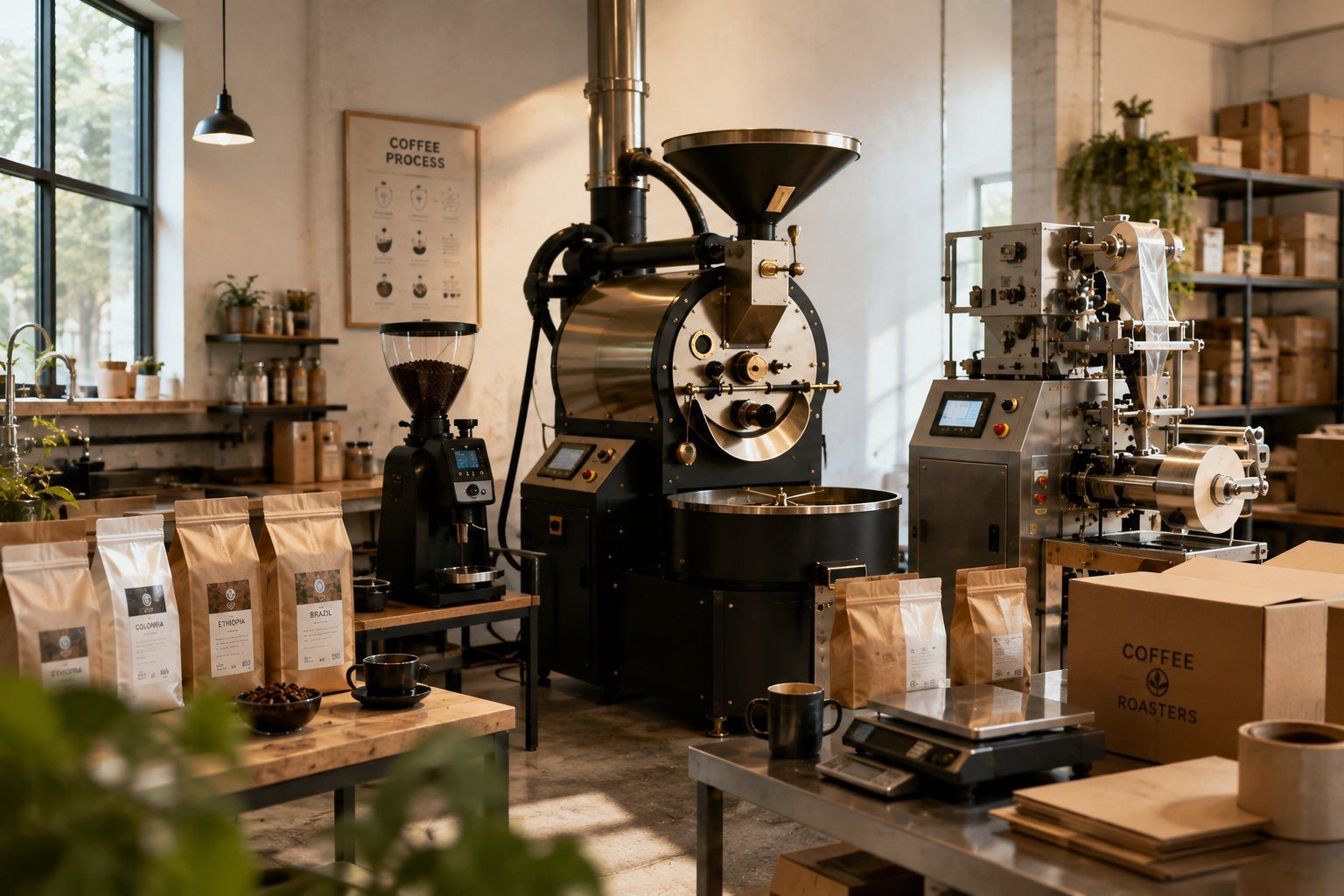
How to Choose Your First Coffee Roaster: Sample vs Shop vs Production
Start With the Archetype, Not the Brand
Most “how to choose a roaster” advice jumps straight to drum vs. fluid bed or gas vs. electric. Those matter — but they come after a more fundamental decision: what kind of roastery are you actually starting?
For a first-time buyer, roasters fall into three archetypes. Pick the wrong one and you either outgrow it in six months (and eat the loss) or overpay for capacity you’ll never use.
- Sample roaster (0.1–1 kg): A profiling and R&D tool. It is not a production machine, even though some startups try to run a business on one.
- Shop roaster (3–15 kg): The standard first production roaster for cafés, hybrids, and independent roasteries. This is where most roasteries should start.
- Production roaster (30 kg+): Wholesale-scale. Almost never the right first roaster unless you already have contracted volume.
If you’re weighing the deeper technical tradeoffs (heating method, control systems, venting), read our companion piece: How to Choose the Right Coffee Roaster for Your Roastery. This guide is about which archetype to buy first.
The Three Archetypes, Side by Side
| Factor | Sample (0.1–1 kg) | Shop (3–15 kg) | Production (30 kg+) |
|---|---|---|---|
| Best role | Profile dev, QC, training | First production roaster | Wholesale / high-volume |
| Weekly output | < 5 kg | 20–200 kg | 500 kg+ |
| Footprint | Countertop | Behind a bar / small room | Dedicated room + exhaust |
| Typical price | $1,500–4,000 | $4,000–15,000 | $15,000–60,000+ |
| Venting needs | Minimal (often ductless options) | Standard rated exhaust | Afterburner often required |
| Resale risk if you outgrow | High | Low (liquid market) | Low |
Decision 1: Do You Actually Need to Roast Yet?
If your weekly volume is under ~5 kg, you probably don’t need a production roaster at all — a sample roaster covers profiling and small-batch sales, and you can outsource production until demand justifies equipment. The mistake is buying a 15 kg shop roaster to roast 3 kg a week: you’ve spent capital and taken on venting/footprint you don’t need.
Use a sample roaster as your first machine if: you’re validating a roast profile, supplying a handful of accounts, or roasting for a single café’s own bar.
Skip straight to a shop roaster if: you have (or have committed) 20+ kg/week of demand, a viable sales channel, and a space that can be vented.
Decision 2: Size for 12–18 Months Out
The single most common first-roaster error is buying for today’s volume. A roaster running at 70–80% of rated capacity gives you headroom without overinvesting.
A practical rule: take your realistic weekly volume in 12–18 months, divide by your planned roast days, and size the batch so you’re running 2–4 batches per day — not 8. Running 8 small batches a day burns labor and increases defect chances.
Decision 3: Don’t Buy Production-Scale as Your First Roaster
A 30 kg production roaster assumes you already have wholesale contracts, a dedicated room, an afterburner, and three-phase power. Buying one “so you don’t have to upgrade” usually backfires: the capital sits idle, the footprint locks your layout, and the learning curve is steep.
Buy the shop roaster. Prove the business. Add production capacity later (see Scaling a Coffee Roastery: When to Add a Second Roaster).
The Pre-Purchase Checklist
Before you commit, confirm all of these:
- Weekly demand (current + 18-month forecast) is documented, not guessed
- Power service matches the roaster’s rated draw (single-phase vs three-phase)
- A rated exhaust / venting path is feasible in your space
- Gas line (if gas roaster) or adequate electric service is available
- A matching grinder and bag sealer fit your throughput (roaster output is useless if you can’t grind and pack it)
- Spare-part availability and a local or responsive service network exist
- You’ve factored install + venting + training into the budget, not just the machine price
Matching the Roaster to Your Model
Different roastery models lean toward different starting points:
- Independent roastery supplying cafés and retail → start with a 5–12 kg shop roaster. See how we equip independent roasteries.
- Café + roastery hybrid roasting for own bar + some retail → a 3–8 kg shop roaster behind the bar. See café + roastery setups.
- Wholesale production with committed accounts → you may already be past “first roaster” territory; plan capacity deliberately. See wholesale production.
What Comes After the Roaster
Your roaster is only the start of the line. Budget and plan for the equipment that makes roasted coffee sellable:
- A low-retention commercial grinder for QC and retail
- Packaging & sealing equipment for retail bags
- Water filtration for consistent cupping
Browse the full lineup of coffee roasters to match a model to your volume and footprint.
Next Step
The fastest way to avoid an expensive wrong turn is to spec the roaster against your actual numbers. Contact our team with your weekly volume, available space, and power — we’ll recommend a starting point and a realistic upgrade path. If you’d like to map out your full equipment lineup first, our equipment selection guide walks through choosing a roaster, grinder, and packaging together.