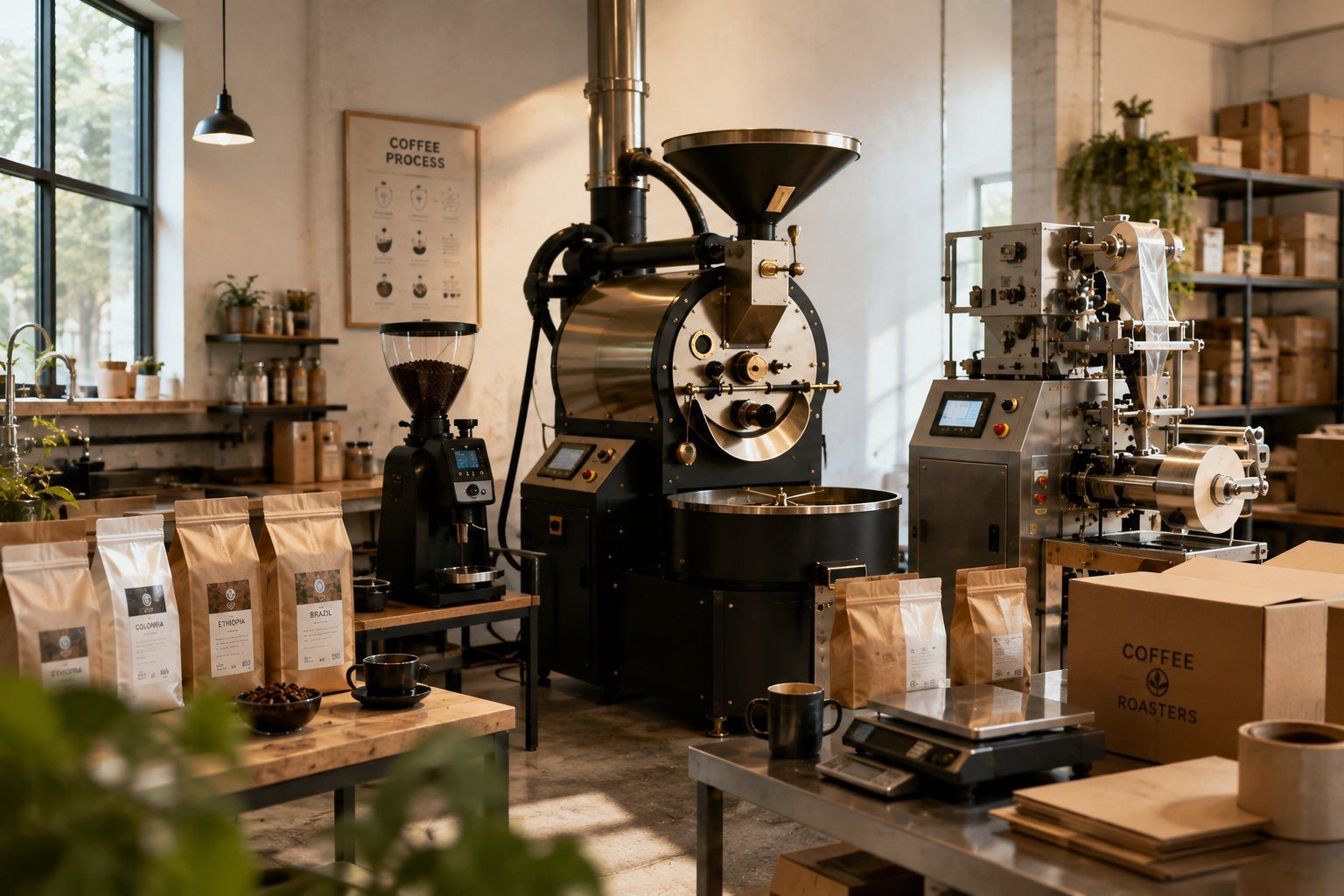
For Small & Growing Coffee Roasters
Practical equipment for roasting, grinding and packaging coffee as your business grows.
Every roastery starts from a different place. Pick the stage that fits yours — then we help you match the right roasting, grinding, and packaging equipment.
Not sure which stage you're in? Use our setup guide ›Build your first roasting setup — sample batches, daily production, and the packaging to put your name on it.
Explore SolutionReplace aging equipment, expand capacity, or step up to a larger roaster without disrupting daily output.
Explore SolutionMove from hand-sealed bags to automated or semi-automated packaging — better consistency, less labor, more retail-ready.
Explore SolutionKeep roasters, grinders, and packaging equipment running reliably — with the right spare parts, replacement components, and consumables.
Explore SolutionExplore our complete range of professional coffee equipment.
Sample, shop, and production roasters — sized to small and growing coffee roasteries.
Production, QC, and bulk grinders matched to your roastery's daily throughput.
Form-fill-seal, chamber vacuum, heat and impulse sealers for daily bag production and retail-ready packaging.
Coffee bags, degassing valves, water filter cartridges, scales — supplies that keep your roastery running.
Opening a marketplace and piecing together a roaster, grinder, and packaging line yourself leaves you guessing on sizing, compatibility, voltage, and certifications. CoffeeEQ shortlists equipment matched to your stage and volume — from one sourcing partner — so the pieces actually work together.
Learn More About UsEquipment picked for small roasteries — not generic food-service gear.
Shortlists sized to your real daily batch count and SKU mix.
One contract for your whole workflow — fewer vendors to manage.
Choices matched to your stage, with upgrade paths built in.
Make confident equipment decisions — capacity planning, sizing, and selection criteria for new and growing roasteries.
Understand how roasting, grinding, and packaging equipment actually works — principles, maintenance, and best practices.
Build, run, and grow a coffee roastery — business planning, operations, scaling, and the commercial decisions behind every equipment choice.
Industry news, roaster profiles, case studies, and updates from our team — the broader coffee roasting conversation.
Answers to the equipment-selection and purchasing questions roasteries ask before they buy.
It depends on your batch volume, not the volume you hope to reach. A sample roaster (100g–500g per batch) is for profiling and QC. A shop roaster (1–5kg per batch) suits café-side roasting and small retail. A production roaster (10–60kg per batch) is for daily wholesale. Batch capacity is not daily output — a 5kg roaster run several times a day can out-produce a larger machine run once. Our setup guide walks through the tiers.
If you grind for espresso, filter service, or retail bags, yes. A professional burr grinder supports both QC lab use and retail-bag prep, and its throughput should keep pace with your roaster. Most roasteries start with one grinder and add a higher-throughput unit as volume grows.
Sample roasters are small-batch development tools — profile, cup, and test before you commit. Shop roasters are your first production machine (1–5kg drum, or compact electric 200g–2.5kg). Production roasters (10–60kg, gas, automated profiles) are for established wholesale operations. The usual first step is sample → shop, then production once wholesale is committed.
Start from realistic weekly output in kilograms, then work back to kg-per-batch and batches-per-week. Size to your year-one reality, not year-two hope, but leave a little headroom so you're not replacing the machine within 12 months. Our stage pages and setup guide frame this against real product batch ranges.
Electric roasters (compact, roughly 200g–2.5kg) suit spaces without gas lines or large footprints. Gas production roasters (10–60kg) deliver higher volume and automated profiles. Your available utilities, ventilation, and local codes usually decide — tell us your site constraints and we'll narrow it down.
When daily bag volume makes hand-sealing the labor and consistency bottleneck — uneven seals shorten shelf life and slow you down. Start with a heat or impulse sealer, then step up to a form-fill-seal line as daily bag count grows. The Packaging solution outlines the automation path.
Yes. Share your expected output and target end-use — retail bags, wholesale, or on-site brew — and we'll shortlist two or three roaster and grinder pairings sized to your operation, so you can compare before committing.
Yes. One sourcing relationship can cover your full workflow — roasting, grinding, packaging, water filtration, and consumables — with consolidated documentation and lead-time planning across categories, instead of managing several vendors.
Your expected daily or weekly output, target end-use, voltage and certification region, and any space or ventilation constraints. The more specific you are, the tighter the shortlist we can prepare.
Primary markets are North America (US, Canada) and the Middle East (UAE, Saudi Arabia); other regions are available by consultation. We confirm feasibility, voltage compatibility, and certification requirements for your destination before you order.
Standard production lead time is approximately 15–25 days after order confirmation, depending on the equipment category and any customization. Shipping is typically 7–15 days by sea freight or 3–5 days by air express. We confirm a specific timeline when quoting.
Certification is confirmed per destination market rather than assumed. Requirements vary by region (for example CE for the EU, FCC/ETL for North America), so tell us where you'll operate and we'll verify the applicable marks against your specific model and destination before you order.
We support ongoing reliability with replacement components and spare parts matched to your equipment model, plus recommended service intervals. Specific warranty terms are confirmed per supplier and per order — ask when you request a quote and we'll document them for your records.
Our setup guide walks through stage, capacity, and workflow — or talk to us directly about your roastery.
Get in touch for quotes, catalogs, or custom solution inquiries.